

How to Start Practicing Church
Most Bible studies end with good intentions. Jesus trained His disciples to hear, obey, report back, and pass it on.

A new disciple in Queens named John has spent all summer going down to the handball courts at Hoover Park. Regularly each week. The guys down there are rough around the edges and a little leery of an outsider, but he keeps showing up, and lately a few of them have let him start talking about Jesus.
Last week John got into a meaningful and spiritual conversation with one of the men there. The man’s twins were running around the court, and partway through telling him about Jesus, one of the kids started acting strange. Off in a way John was trying to read. And what flashed in his mind was Mark 9, the father who brings his son to the disciples, and he’d read that exact chapter that morning.


Then on a break between games he pulled a couple of other disciples aside, opened the Bible right there, and they read Mark 9 together, trying to work out how that father came to the disciples and what John should do next. He’s still in the middle of it. But the chapter he read that morning turned into the exact thing he reached for hours later, with real people, in a real moment, because he was out there in the first place.
Here’s the thing.. that almost never happens.
Most Bible studies end one step too soon. The discussion is good. Somebody underlines a verse. Somebody even tears up. Everybody agrees it was meaningful, and then everybody goes home and nothing changes. We studied what Jesus said, we felt something about it, and not one person did anything different that week.
If you lead a group, you know that feeling. Good discussion, real warmth, almost no change. You can sense the distance between what Jesus said and what your people actually do, and you’re not sure how to close it. You don’t want a slicker study. You want obedience to feel normal, and instead it all stays up in your head.
The last article I wrote made the case that church isn’t mainly something you attend. It’s a life you practice with other people. True! But that leaves a hard question. How do you help an ordinary disciple start living that way without burying him under more stuff to learn?
The honest answer is short. Command, story, one thing to obey, report back, hand it on. That’s the process I want to unpack with you.
A command gives direction. A story gives it a body.
A command on its own can stay in the realm of our intentions. “Love one another” sounds obvious right until loving somebody costs you your Saturday (or two hundred bucks, or a friendship). “Repent and believe” can shrink to a feeling you had at summer camp. “Go and make disciples” can hang on a church wall for years without being a part of Monday the next day.
A Bible story gives a command an example to follow. You see somebody actually do it, and you see what it cost them, what got in the way, and what Jesus was really after.
And here’s the key to how they fit together: the story doesn’t make the command easier. It makes it tangible. A command gives direction. A story gives it a body. Obedience turns it into a way of life.
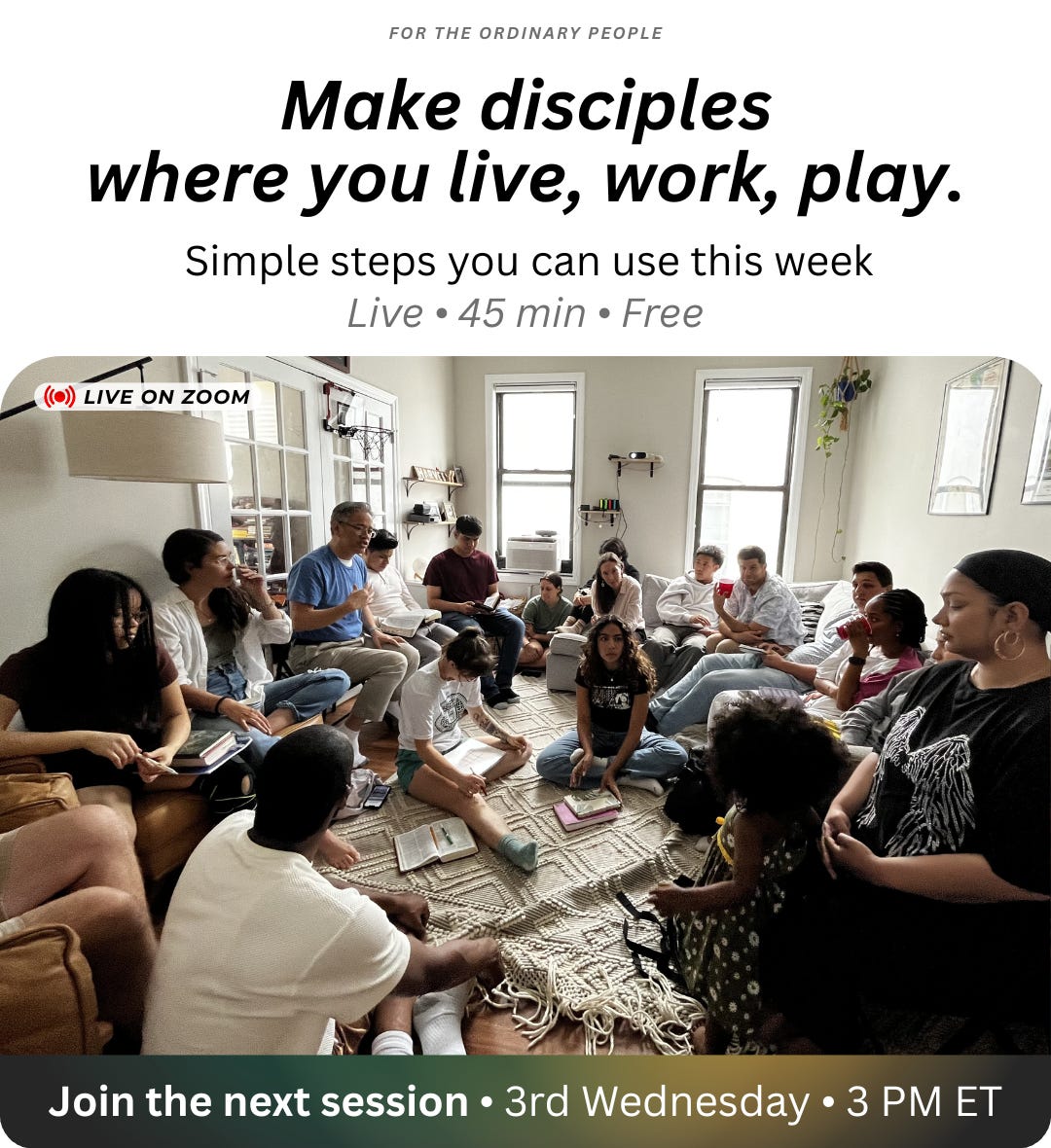
Next Lab: “The Aquila and Priscilla Pattern” (Wednesday, July 15th at 3PM ET). Learn from the example of a power couple God used through their home and job.
Zacchaeus Gives Repentance an Example
Take the command to “repent and believe.” People can make repentance one of feeling guilty, saying sorry, raising a hand at the back of a service, promising to do better.
Then you read Zacchaeus. Jesus invites Himself over to the house of a man the whole town can’t stand. Zacchaeus climbs down out of the tree, takes Him in, and the change lands on the stuff you can actually see. He gives half of what he owns to the poor. He pays back four times what he cheated out of people, out loud, in front of the whole town. Repentance is placing your whole life, bank account and all, under the lordship of Jesus.
So you don’t stop at “what does repentance mean?” You ask the guy across the table: how is Jesus asking you to obey this story like Zacchaeus did? Anybody you need to make right with? And then you help him get specific. “Before Friday I will call the guy I cut out of that deal, telling him straight what I did, and asking what it’ll take to fix it.”
Now repentance has feet.
The Good Samaritan Makes Love More Than a Feeling
Same with the command to love our neighbor. Everybody already agrees with love, right? Intention to love is not the hard part. Love just stays vague enough to ask nothing of you.
Then Jesus tells the story. The Samaritan sees the man bleeding in the ditch, crosses the road, stops his whole day. He cleans the wounds, puts the guy on his own animal, pays for the room out of his own pocket, and tells the innkeeper he’ll be back to cover the rest.
The story won’t let love stay a feeling. It stops, goes across the road, spends money, carries the responsibility, and comes back to check.
You can’t read that and still ask whether you feel loving enough. You will start asking who’s bleeding in a ditch near you, and what you’re going to do about it this week.
Luke 10 Gives the Great Commission Feet
Same with the call to “go and make disciples” (which can feel big and vague). Make disciples of all nations. Teach them to obey everything Jesus commanded. For somebody who frames houses all week or runs a register, that lands as important and impossible at once.

Then Luke 10 gives “go” a shape you can see. Jesus sends them out two at a time, into real towns, carrying almost nothing and praying for more workers as they go. They walk into homes, carry peace, take whatever they’re handed, and tell people the Kingdom has come close. They stay where they’re received and move on where they’re not. It turns “go” from a slogan into a short list two regular people can do on a weekday.
So you stop saying “we should be more missional” and you say “At work this week a couple of us are reading our Bible together on break, starting a couple of conversations, and asking God to point us at somebody who’s open.”

Every Study Has to End With an “I will” Statement
This is the step studies can tend to skip (it’s also the one that changes people.)
Most groups end on good intentions. Pray more. Love people better. Be more generous. Trust God. All real, and all impossible to act on or report on honestly. Nobody can come back next week and tell you whether they trusted God more.
A real goal is a different animal. It answers plain questions. What exactly am I doing? With who? When? You can hear the difference.
“I need to pray more” turns into “Tuesday at 7, Maria and I will pray through our five friends who are curious about God, by name.”
“I should be more generous” becomes “I will put a hundred bucks toward their rent and dropping it off Friday with no name on it.”
“I want to share my faith” comes out as “At lunch tomorrow I will tell James what Jesus did in my life and ask what he thinks about it.”
Vague conviction feels spiritual. A real goal shows up on your calendar.
None of it earns anything from God. It just gives the faith somewhere to go this week.
Accountability is Where the Lesson Becomes Real
Then you come back and tell each other what happened. People hear “accountability” and think control, mostly because they’ve been on the wrong end of it.
The healthy kind isn’t policing or shaming or keeping score. It’s coming back to what you decided and telling the truth about it:
What were you going to do?
How did it go? Where’d you see God?
It’s the pattern Jesus used. He sent them out, they came back, they told Him how it went, and He celebrated the wins, corrected what needed it, and straightened out what they’d misunderstood. He didn’t send them out and then act like the assignment never happened.
So failure stops being the end of the conversation. Failing doesn’t get you kicked out of discipleship. It turns into useful growth examples the second you bring it into the light instead of hiding it.
Practice Becomes Rhythm, and Rhythm becomes Culture
One act of obedience matters on its own. But it’s the repeating that turns a few people into a people.
Watch it move. A group prayer walks the block once, and that’s an event. They start going every Tuesday, and it’s a rhythm. New people show up assuming praying and going out is just part of what this group is, and now it’s the culture. Then some of them start taking others along and opening the same story in a different living room, and it’s spreading.
You know a practice has become culture when the new people assume, “This is just what we do here.”
Reproduction Finishes The Loop
Which leaves the last question. Not just “did you obey?” but “who can you help do the same?”
A guy who just got baptized can open Acts 8 with a friend. The one who finally went out into the neighborhood can bring someone with him next time. For any of that to work, the thing has to stay simple enough to travel without you. One open Bible, one story, one decision, one report, no expert in the room.
Nobody graduates from this. They give it away.
Start Here. How to Use the Church Circle.
Those three, Repent & Believe, Love One Another, and Go and Make Disciples, are part of a set of twelve practices found in Acts 2:36-47.

It’s twelve practices that cover the whole life of a church, from baptism and prayer to the Lord’s Supper, generosity, and gathering. We started calling it the Church Waffle because that’s what it looks like, and it stuck.
Get two or three people around a table. Start with the first command to Repent & Believe. Read the story that goes with it, tell it back in your own words, and ask what it shows you about God and people. Name one thing you’ll obey. Set a time. Decide when you’ll report back. Then ask who else could learn it.
Start small enough to obey, but clear enough to know whether you did with an “I will” statement.
Give The Command Hands and Feet
Back to the handball courts. John didn’t have a clean answer that afternoon, but he had Mark 9 open and a couple of disciples next to him, because the chapter he read that morning didn’t stay on the page. A command to “Go and make disciples” had walked him out to a park full of strangers and put Scripture in his hands in the middle of a real moment.
That’s the vision, and it’s available to all of us. Read a command. Watch somebody in Scripture live it. Listen for How Jesus leads you to obey. Come back and share about how it went. Then teach the next person to do the same.
A command gives direction. A story gives it a body. Obedience turns it into a way of life.
You can agree with this article and still change nothing.
Our labs are for people who are ready to stop drifting and take one clear step.
Next Lab: “The Aquila and Priscilla Pattern” (Wednesday, July 15th at 3PM ET). What disciples do that see traction and new disciples made.

Fun article! Great to hear about the gospel being shared. Just an exegetical note: the "go" in Mt. 28:19 is not a command. Interestingly, it has very little grammatical force. It's a participle expressing attendant circumstances. Which means you could translate it: "While going." There isn't really a "go" in the Great Commission. The command is "make disciples." Why is this interesting and helpful? Because it means the making of disciples occurs as people are going about their daily lives. Yes, some have the vocation of missionary as their daily life, going to far off lands or groups (like St. Paul). But the "going" of others is making disciples of their children by having their babies baptized and catechized and demonstrating obedience to the way of Christ. Or, like you point out, sharing the gospel with a coworker or someone on the court. Getting the "going" right helps us understand how we can all obey the "make disciples" part in our respective contexts and vocations. Good stuff.
"Vague intentions" is absolutely true. It reminds me of Dallas Willard's VIM model. Another excellent article on modern discipelship practices. Thank you!