

7 Habits That Quietly Kill Disciple Making
The problem usually isn't desire. It's what our daily rhythms are quietly training us to avoid.

Most Christians want to make disciples.
That’s not the problem.
The problem is that disciple making starts where Peter started in Acts 2: Jesus is Lord. Not coach. Not inspiration. Lord. And most of our daily habits are quietly training us away from what that actually requires.
Not intentionally. Just normally. Which is almost worse.
The gap isn’t theological. It’s not a knowledge gap either. Most committed Christians already know enough. They’ve heard the sermons. They have the frameworks. They could probably teach the class.
The gap is rhythmic.
It lives in what you do every day, what you’re training yourself to notice, what kind of obedience has started to feel natural versus the kind that still makes your stomach tighten. You don’t drift away from fruitfulness by making bad decisions. You drift by making ordinary ones, over and over, until a certain kind of person is just who you are.
And it’s not only personal. We’ve built church cultures that run event to event, mostly prayerless, relationally thin. In Acts 2 prayer wasn’t a private coping mechanism. It was a shared rhythm of dependence. A lot of what kills fruitfulness in our generation is communal before it’s personal. We are all swimming in the same water.
We’ve watched this long enough in NYC to see the pattern clearly. Some people get fruitful over time. Plenty of sincere believers stay stuck in good intentions. The difference almost never comes down to gifting. Almost never comes down to personality.
It almost always comes down to whether someone commits, stays focused on what actually matters, and keeps showing up long enough for ordinary faithfulness to compound into something real.
Commitment. Focus. Consistency. The following seven habits quietly kill all three.
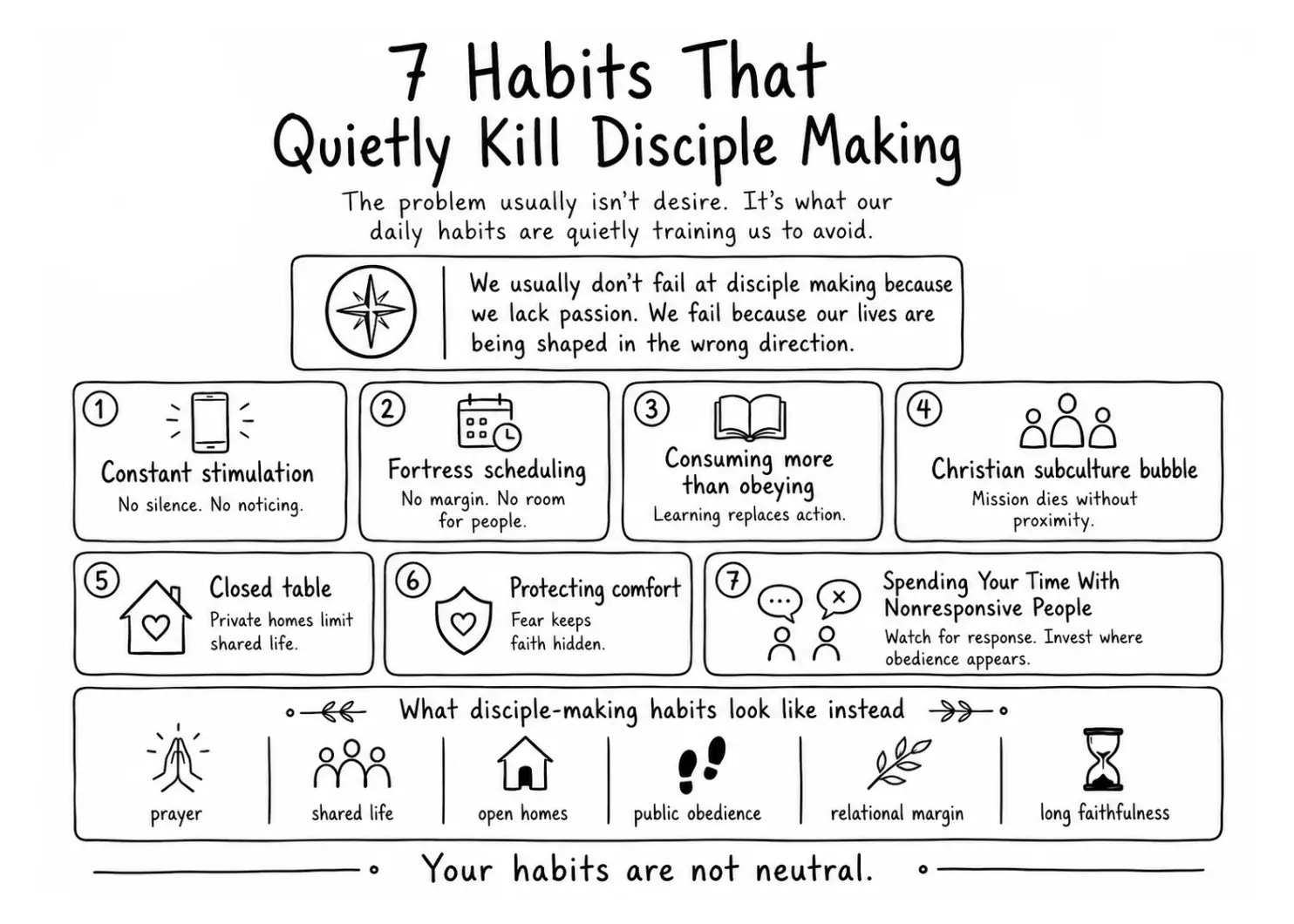
Habit 1: Filling Every Quiet Moment With Stimulation
Phone out before the elevator doors close. AirPods in for the walk to the train. Podcast on during the drive. Scrolling in the pharmacy line, the school pickup line, the thirty seconds waiting for the coffee to brew.
We’ve engineered a life where silence almost never happens.
Here’s what that actually costs: you can’t notice people if your attention never lands anywhere. The guy at the end of your row who’s been quieter than usual this week. Your neighbor who’s outside every evening looking like he’s killing time. The woman you’ve ridden the elevator with a dozen times. You’ll miss all of it. Not because you don’t care. Because your ears were full.
Disciple making runs on noticing.
There’s a prayer problem buried here too. Constant noise crowds out the internal quietness that prayer requires. Not scheduled prayer, the running conversation with God that actually shapes how you move through a Tuesday. That gets squeezed out so gradually most people don’t notice it’s gone. They just feel vaguely disconnected and assume it’s something else.
The shift: Leave deliberate pockets of silence. No phone in the elevator. One commute a week without headphones. Give your attention somewhere to land.
Habit 2: Treating Your Schedule Like a Fortress
We’ve discipled people into church calendars that leave no margin for actual neighbors.
Block the morning for deep work. Decline anything that isn’t a priority. Keep meetings tight. Get home, decompress, repeat. This is the productivity gospel. And it produces a person who is structurally unavailable by 7pm on a Wednesday when a neighbor knocks on the door.
Jesus was interruptible. Worth actually sitting with that.
A demonized man cries out in the synagogue. Simon’s mother-in-law is sick and someone tells him right then. The whole city gathers at the door after sunset. Friends tear through a roof to lower a paralyzed man in front of him. In Mark especially, the kingdom keeps breaking in through interruptions. That is central to the story itself actually.
Most of the people God wants you to reach feel like inconveniences first.
When there’s no margin, the coworker who stops by your desk wanting to talk becomes something to manage. The friend who texts asking to grab food gets “can’t, this week is crazy” because it actually is. The downstairs neighbor stays surface-level because you’ve never had an unscheduled hour to just sit on the stoop. Productive life. Not much room for actual people.
The shift: Build margin on purpose. Not recovery time for yourself. Relational margin. Space where an interruption at 6:30 doesn't blow up your evening.
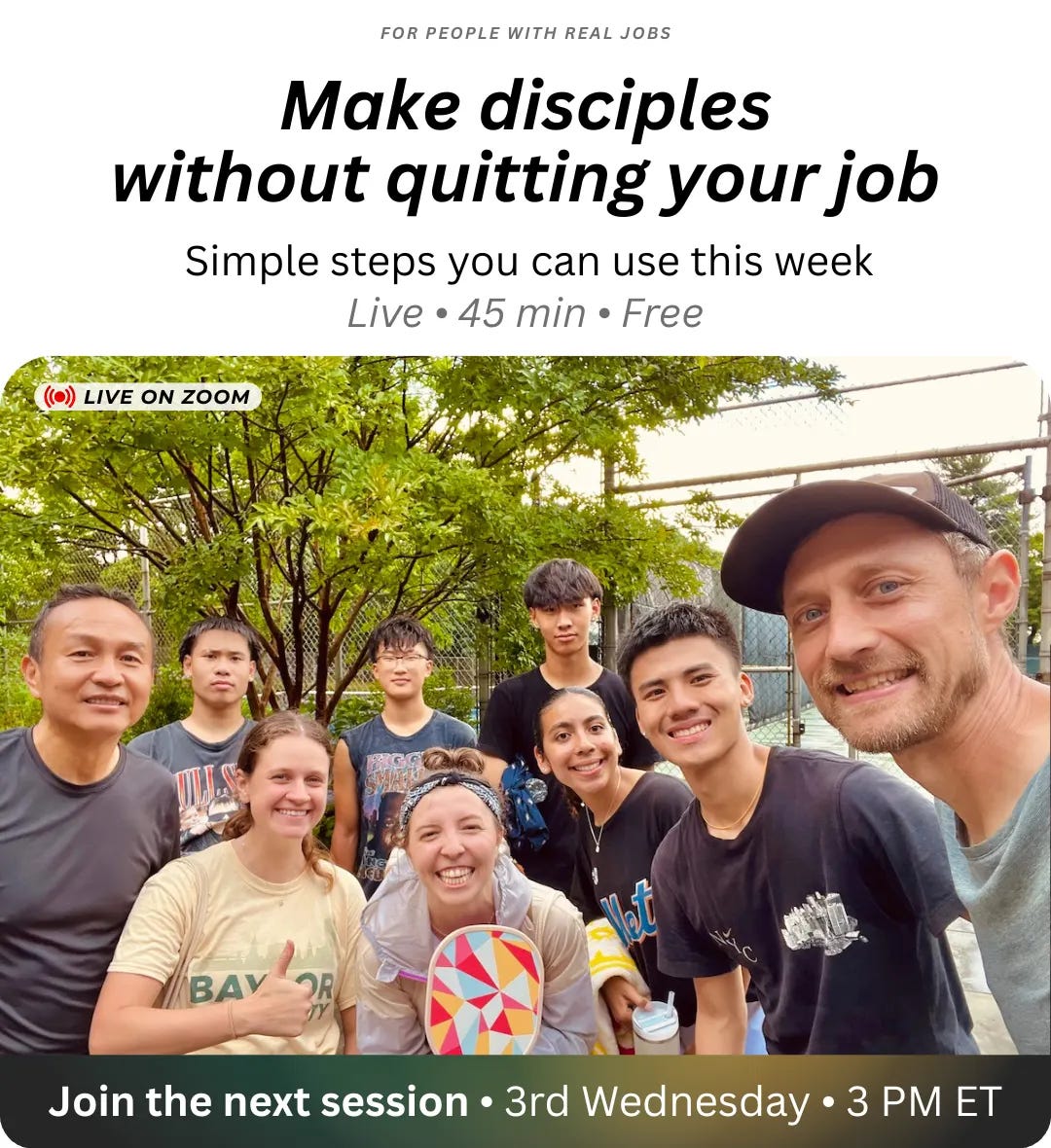
Next Lab: “Rhythms of a Covo Multiplier” (Wednesday, June 17th at 3PM ET). What disciples do that see traction and new disciples made.
Habit 3: Consuming More Than Obeying
We have made learning feel safer than obedience.
The biography. The missional ecclesiology podcast. The discipleship framework from that conference. All of it feels like movement.
None of it requires you to say anything uncomfortable to anyone.
This is the sneaky one, because information genuinely can feel like spiritual growth. You can spend three years getting sharper theologically while never once asking a coworker what they actually believe about anything. You can know exactly what disciple making should look like…have a real theology of it, have read the books, and still not have had a single spiritually substantive conversation this month.
The knowledge is real. The growth is not.
This isn’t a call to stop learning. Just notice the ratio. If you listened to four episodes this week and didn’t act on anything you already knew from last week, something is backwards.
The shift: Before you start something new, act on something you already know. Text the person you’ve been meaning to text. Have the conversation you’ve been postponing.
Habit 4: Living Entirely Inside Christian Subculture
Every close friendship from church. Every regular hangout a small group or church event. Every person you’d call if something went wrong already follows Jesus.
The result is a community that genuinely wants to reach people they haven’t had an unscripted conversation with in months.
You naturally invest in the people you naturally spend time around. That’s not a moral failure. That’s just how human beings work. If the only non-Christians in your week are the cashier at the grocery store and people you pass on the street, your disciple making will reflect that. Regardless of how much you believe in the Great Commission.
Proximity isn’t everything. But it’s where almost everything starts.
The question isn’t whether you believe in reaching people outside the church. The question is whether you’re regularly in the same place, at the same time, doing the same thing as people who don’t follow Jesus. Long enough for something real to develop. That takes longer than most people want to admit.
The shift: Consider your actual social rhythms. Not your theology of mission. Your calendar. Where do you spend unhurried time with people who don't follow Jesus?
Habit 5: Keeping Your Table Closed
In Mark 2, Jesus is eating with tax collectors and sinners at Levi’s house. The Pharisees want to know why. The answer is the whole point.
In Acts 2, the early church ate together in homes with glad and generous hearts and people were being added daily.
The table wasn’t randomly involved in the movement. It was one of the main environments where the new family became visible to people on the outside.
Most of us don’t have that. Not because we’re cold. Because our homes are private by default. Having people over requires planning, energy, a reasonably clean kitchen, and a chunk of margin that most weeks simply don’t have. So it doesn’t happen. And the people who might have come to faith through the slow warmth of repeated shared meals never got that exposure.
The closed table is one of the most common disciple making killers nobody talks about.
Because it doesn’t feel like failure. It just feels like a Tuesday.
The shift: Pick one meal a week, or even one a month to start, and invite someone in. Not a ministry moment. Just food and time.
Habit 6: Protecting Your Comfort From Costly Allegiance
You’re at lunch. A coworker mentions offhand that they’ve been having a rough few months. There’s a two-second window. You could ask a real question. Pray. Share the gospel. Instead you say “yeah, that’s rough” and the conversation moves on.
Or you’re at a backyard thing and someone says they don’t believe in anything anymore, half-joking. You laugh along. Moment passes. You drive home knowing something just didn’t happen.
Underneath that is something deeper than social discomfort.
It’s the fear of being known as someone who actually follows Jesus. Not generically. Not in a culturally acceptable way. In a way that costs something. That changes how people see you at work. That makes some friendships uncomfortable. Following Jesus has always had a social cost and the brain is very, very good at generating reasons not to pay it. The lunch stays pleasant. The backyard conversation stays light. The relationship stays exactly where it was.
The people who make disciples have mostly just gotten more comfortable sitting in that two-second window without bailing.
That’s it. That’s most of the difference.
The shift: The next time a conversation could go somewhere meaningful or spiritual and you feel the pull to deflect, don’t deflect. Ask the follow-up question. Here’s how:

Habit 7: Spending Your Time With Nonresponsive People
Some people are curious but never obedient.
They like spiritual conversations. They like being pursued. They like processing. But every next step dies in the same place. They don’t read the passage. They don’t show up. They don’t act on the simple thing in front of them. Always thinking about it. Always almost ready. Always available for another long conversation that doesn’t turn into anything.
This is hard to name because it can feel spiritual to keep giving them your best hours. Patient. Compassionate. Like love.
But Jesus was not careless with his attention.
He loved the crowds. He didn’t build the movement on the crowds. He called people to follow and then he watched who responded. Simon, Andrew, James, and John leave their nets immediately. Levi gets up from the tax booth. Those who receive the word are baptized and devote themselves. The pattern is not: invest forever in whoever keeps absorbing attention. The pattern is: proclaim widely, love freely, watch for response, invest deeply where obedience actually appears.
Disciple making requires compassion for everyone. Not equal investment in everyone. Some people need kindness, prayer, and an open door. Others need your deepest time because they are ready to obey and pass it on. The habit that quietly kills disciple making is giving your best energy to people who keep talking while avoiding obedience…while somewhere out there, the responsive ones wait.
The shift: Look for response, not charisma. Give a clear next step. Watch what they do. Invest deeply where obedience appears.
None of these habits are dramatic. That’s exactly the point.
They don’t feel like failure. They feel like a full week. Packed calendar. Good podcast on the commute. Small group on Thursday. Theology book Saturday morning. Quiet Sunday dinner at home. Most Christians would call that a solid rhythm.
Stacked together, they quietly produce someone who is increasingly unavailable for the slow, awkward, costly, ordinary work that disciple making actually requires.
The early church wasn’t built by disciplined people with better habits. It was built by ordinary people filled with the Spirit, devoted to each other, eating in each other’s homes, praying together, and obedient in public long before anything dramatic happened. That’s still what it looks like. It has always looked like that.
Habits are just patterns. Patterns can change.
One more thing worth saying: long faithfulness doesn’t mean chasing the same unresponsive person forever. Stay faithful to the mission, not stuck in one relationship.
Five years from now, your rhythms will not be neutral. They will either compound into fruitfulness or quietly train you away from it. There’s no middle.

Walking away with a good measure of conviction and ideas to ponder more. You did a great job of tenderly, yet boldly presenting these challenging ideas. Excellent.
Great post, Mark!