



Rodger Shull started tracking his gospel shares one year in Houston. In one month his team hit 1,200 conversations. The next month, 800. Averaged out, that’s over a thousand people a month, all year.
That should feel like a win. Then Roger looked at the other number. Houston adds more than 10,000 new residents every single month. His team wasn’t reaching the city. They weren’t even keeping pace with the people moving into it.
That’s the difference between addition and multiplication, and most of us are doing addition while calling it multiplication.
Roger moved to Raleigh-Durham and kept building. A few years in, the network hit fourth-generation churches for the first time. Exciting, for about a week. Then he did the math again. Fourth generation added up to seven churches. Good work. Still nowhere close to the size of the problem.
Raleigh-Durham has two million people. An estimated 1.6 million of them are lost. Seven churches doesn’t move that number. So Roger and his wife spent a year and a half praying through a different question: what would it take to actually reach this metro?
The answer wasn’t “grow our network.” It was “stop having just our network.” If Roger keeps planting one network that produces a handful of churches a year, he’s capped. But if that network produces other multiplying networks, the math changes. Ten networks instead of one gets you into the hundreds of churches and over a hundred baptisms a year. That’s the number where it starts to feel like you’re actually making a dent.
So the goal became specific: ten multiplying networks in Raleigh-Durham by 2030.
This year’s target inside that goal is six to ten potential catalysts, people capable of starting a new network, with the hope that three of them actually do it. Not everyone who looks like a multiplier turns into one.

Read more from Rodger in this article where he shares the vision.
How do you find people like that?
Roger went back to how Jesus did it, and the answer surprised him. Jesus didn’t post a job listing or run an assessment. He worked his relational network. He went to his cousin John the Baptist, who already had disciples, and two of them, Andrew and John, followed Jesus on John’s word alone. Andrew went and got his brother Peter. After the wilderness, after Nazareth tried to throw him off a cliff, Jesus landed in Capernaum, found Peter and Andrew again, and kept pulling the thread: James and John, then Levi the tax collector right outside town.
He found his multipliers by engaging the people he already knew in his oikos, and the people they knew.
Roger admits this scared him. He’s not a magnetic personality. People don’t flock to him. So when he sensed God pointing him toward the same relational method, his honest reaction was closer to “you mean I just have to make friends with a lot of people?”
That’s exactly what it turned out to be. Roger didn’t recruit his first catalysts. They came through people who already trusted him, sometimes two links removed, someone who knew someone who knew Roger.
One of his first connections, a guy he calls Tom, had already tried and failed to build a network of twelve churches that collapsed back to one. Tom kept reaching out through his own friends until the thread led to Roger. They talked, realized they wanted the same thing, and started meeting monthly with other catalysts to share what God was doing and problem-solve together. Not a program. Not a curriculum. A community of practice, the kind of thing you can’t schedule into existence.
What Roger is actually looking for
After enough of these conversations, Roger and other leaders in his network sat down and named the pattern. A real catalyst usually shows a few things early:
A genuine passion for Jesus, not performance.
A burden for the lost that shows up as action, not sentiment.
They’re already leading something, and they’re not hedging by staying part of another church while they experiment.
And they can articulate a vision too big to pull off alone, one that requires multiplication to reach.
Here’s the line that matters most from that conversation. You can train someone on a pathway. You can hand them a process, a tool, a four-fields framework. What you can’t train is passion for Jesus and the lost and commitment to multiplication.
So Roger stopped screening for skill and started screening for conviction. Skill you can build after the fact.
Why immersion beats explanation
Once Roger finds someone, the next problem is training them without turning discipleship into another program. My phrase for this: you can’t give away what you can’t see.
Most of the catalysts Rodger works with weren’t looking for information. They already knew the Bible. They were stuck on one question: what actually works? So instead of teaching a class, Roger tries to get them into a room where it’s already happening. He’s been talking with a leader in Houston about taking his group down for a few days to watch a healthy, reproducing network up close.
That’s Jesus’s model too. He didn’t explain fishing for men in a lecture. He took his disciples fishing and let them watch, then help, then do it themselves while he stood back, then sent them out on their own.
Modeling before explaining. Assisting before launching. You learn to multiply by standing next to someone who’s already doing it, not by hearing about it secondhand.
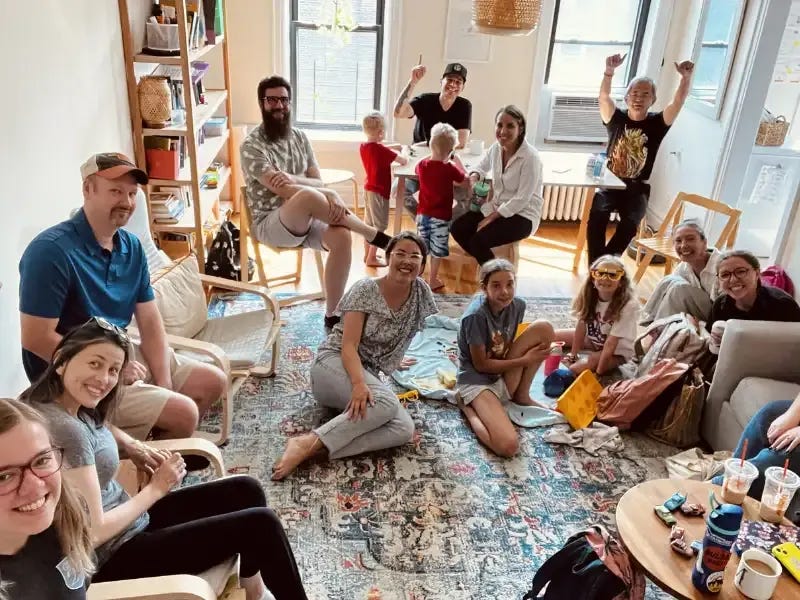
You do not need to imagine this.
Come see it.
Join a Covo Multipliers In-Person Immersion
Most leaders leave training with language, tools, and good intentions, but still feel stuck when they step back into their actual week.
Aim, then adjust
Roger’s closing thought ties the whole thing together. You need a target. Without one, you’re an archer shooting blindfolded, and any decent option starts to look like the right one. A vision that actually comes from God points you past good options toward the best one.
But a target isn’t a guarantee. His mentor Bill Smith put it plainly: if you keep doing what you’ve been doing, you’ll keep getting what you’ve been getting. So Roger’s rule is to commit to a method, run it hard, try it a hundred times if that’s what it takes, and only then go back to prayer and the Word to ask what needs to change. Plant your flag. Walk toward it. Adjust as you go. That’s not indecision. That’s how you actually get somewhere.
Thank you Jonathan Walls, Mark Perri, Mazingi, Linda Upchurch, and many others for tuning into my live video with Rodger Guigou Shull!
Subscribe to Rodger on Substack below:


