

How to Move a Conversation Toward Jesus
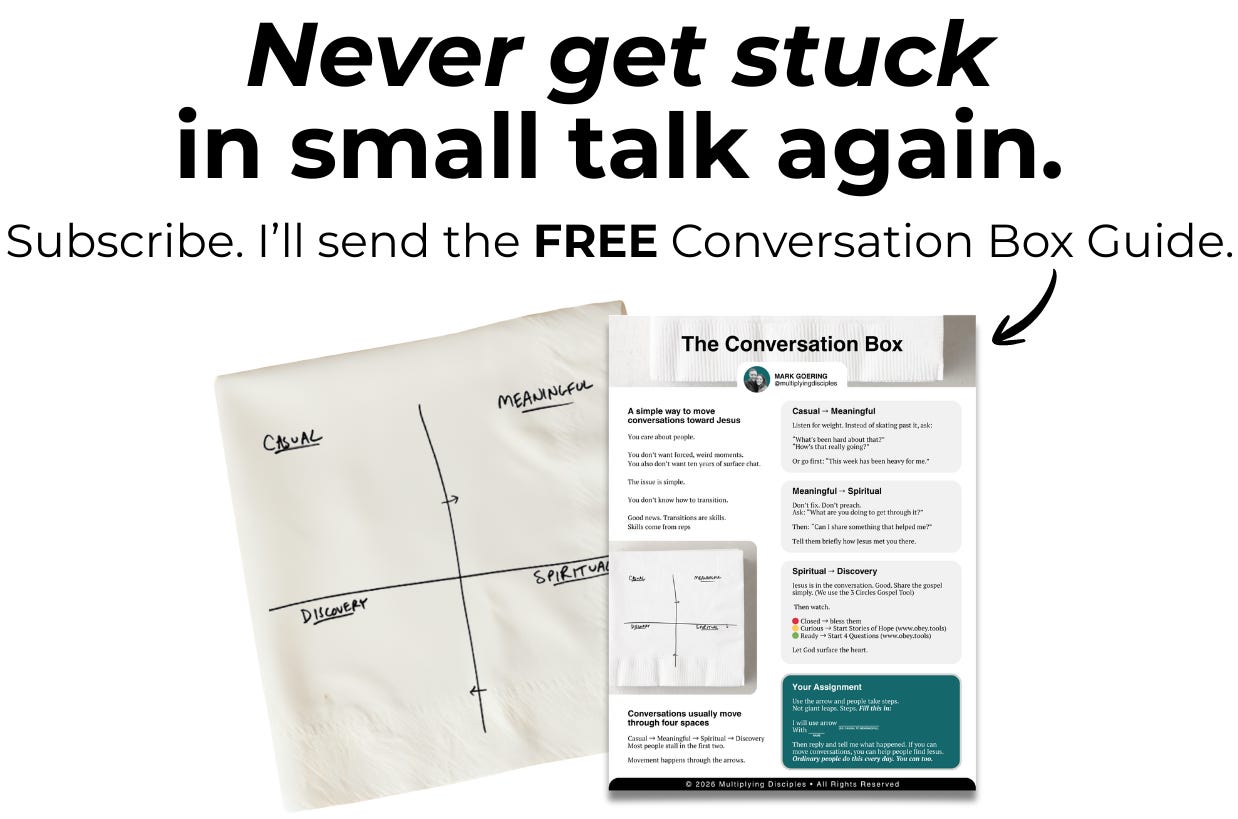
The Conversation Box

You care about people.
You want the conversation to matter. But somehow it stays shallow or gets awkward.
Later you replay it in your head. Missed opportunity.
You knew there was something there. A moment when you could have asked the next question. Could have shared your story. Could have moved from surface talk to something real.
But the moment passed.
And you stood there talking about the weather while their marriage was falling apart.
The core problem
It isn’t love. You genuinely care.
It isn’t knowledge. You know enough about Jesus to point someone in the right direction.
The problem is you don’t know how to move naturally from one kind of conversation to the next.
So you do what most people do. You either park in small talk forever or you jump straight into preacher mode.
Both kill momentum.
Small talk feels safe but goes nowhere. You can spend years with neighbors, coworkers, even family members and never get below the surface.
Preacher mode feels bold but will often connect well only with those ready to follow today.
The goal is to hit the sweet spot of confident sharing and invitation to next step discovery.
The role shift
You are not there to impress.
You are not there to win the argument or deliver the perfect evangelism pitch.
You are there to let the good news work and guide discovery.
Think about it. When do things really stick in your life? When someone tells you what to think, or when you discover it yourself with guided discussion?
If they say it, it sticks.
If you say it, you’re just another person with an opinion.
You stop performing. You stop fixing. You stop trying to close the deal. You start asking better questions. You start listening for what the Spirit is already doing. You start creating space for people to take their next step.
The Conversation Box

Four spaces conversations tend to move through. See the online tool here.
Casual. Meaningful. Spiritual. Discovery.
The key is not in filling in the boxes. Lots of people can describe the difference between shallow and deep conversation.
The secret sauce is the arrows.
The arrows are the moves that carry conversation from one space to the next. They are specific, learnable skills. Not complicated. Not reserved for specially gifted people.
Just skills.
Screenshot this: The 3 arrows
Casual → Meaningful
Questions: “Good week or heavy week?”
Statements: “This week has been heavy for me because...”
Meaningful → Spiritual
Questions: “What are you doing to get through this?”
Statements: “I used to cope by ____. Now I pray/read the Bible/etc.”
Spiritual → Discovery
Gospel conversation, then read the traffic light:
🔴 Red = closed, bless them and move on
🟡 Yellow = curious, use Stories of Hope
🟢 Green = ready, move to discipleship
Box 1 → Casual
Weather. Food. Work. Kids. Music.
Normal life.
This is where every conversation starts. There is nothing wrong with this space. It builds rapport. It establishes that you’re a normal human who can talk about normal things.
People can smell agenda from a mile away. If they sense you’re just waiting for your chance to pounce with the gospel, they shut down.
So you’re genuinely present. You ask about their weekend. You talk about the game. You complain about traffic.
You’re human with them.
But you’re also listening. Not just to their words. To what’s underneath. To the weight they’re carrying. To the places where normal life is not working for them.
That’s when you use the first arrow.
Arrow: Casual → Meaningful
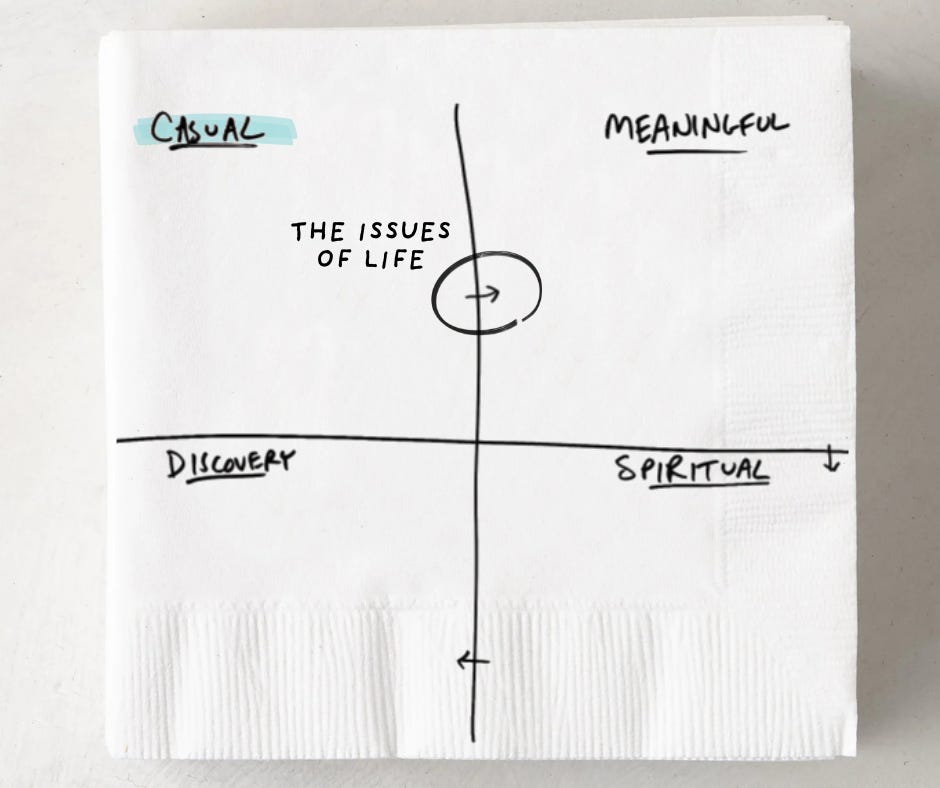
You have two tools here: questions and statements.
Questions open up dialogue.
You are listening for weight.
Someone mentions their job. Most people respond with casual banter. You could too. But you notice they said it with a sigh. A little edge in their voice.
So you ask:
“What’s been hard lately?”
Or:
“What’s been challenging with ____?”
These questions signal you actually care. Most people want to talk about what's real. They just don't know who will be receptive. Your question answers that.
Statements model going first.
Sometimes people need to see vulnerability before they’ll risk it.
So you share:
“This week has been heavy for me.”
Or:
“I’ve been dealing with some stress at work that’s been harder than I expected.”
You go meaningfully honest first. Often they follow.
Box 2 → Meaningful
Real stuff shows up.
Fear. Pressure. Relationships. Money. Health. Kids going sideways. Parents dying. Dreams collapsing.
And here’s where most Christians blow it. We go straight into fix-it mode. We offer advice. We pull out scripture. We try to solve the problem.
Stop.
You listen.
Ask follow-up questions. Validate what they’re feeling. Acknowledge how hard that must be.
You are not trying to get anywhere yet. You are building trust.
This is the space where friendships deepen. Where coworkers become actual friends. Where neighbors start opening up.
Stay here for a bit, but don’t camp out. You will move to spiritual proactively by living loud, not by waiting for their spiritual crisis.
This is what it means for us to be salt and light as Christians.
Arrow: Meaningful → Spiritual
Skill: connect their story to yours
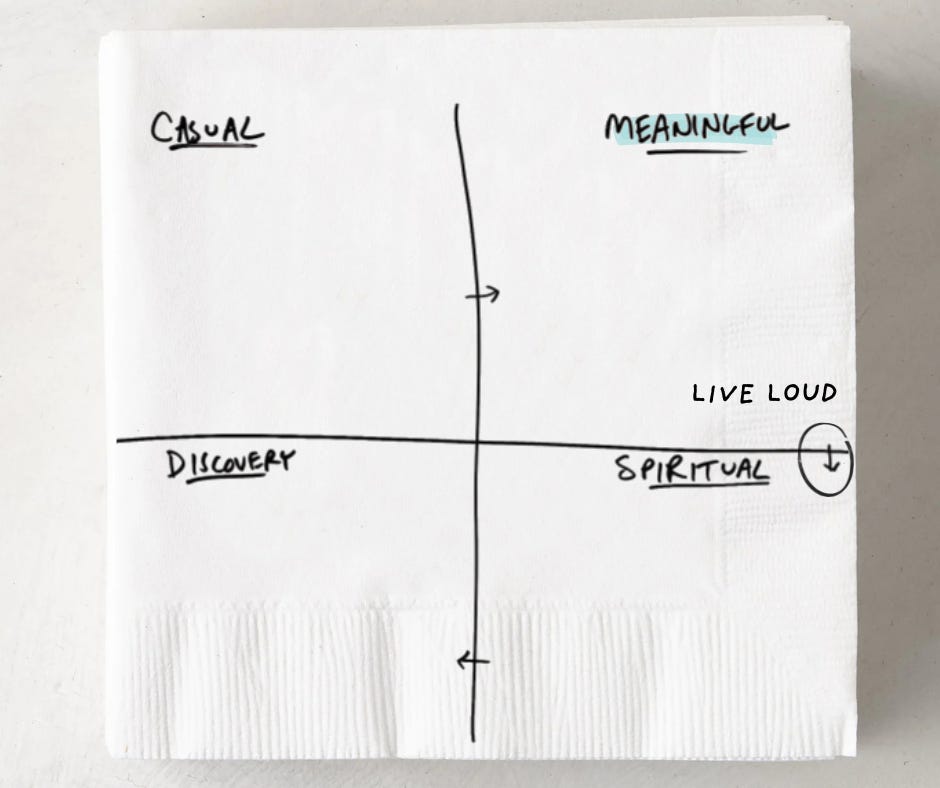
Arrow: Meaningful → Spiritual
Questions draw out their search.
They just told you about their struggling marriage. Or their anxiety that won’t quit. Or their kid who’s breaking their heart.
So you ask:
“What’s helping you get through this?”
Or:
“How are you coping?”
Sometimes they’ll mention prayer, or faith, or God. Sometimes they won’t. Either way, you’ve opened the door.
Statements connect their story to yours.
This is where courage kicks in.
You get to live out loud.
You’ve been there. Or somewhere close. And you know what helped.
Simply live loud and share how following Jesus has changed how you deal with the issues of life.
So you say:
“Can I share something that helped me when I went through that?”
Or even:
“I pray when I face stuff like this. Can I pray for that for you right now?”
Most people are open if you are human.
Notice you’re not preaching. You’re not switching into a religious voice. You’re sharing your testimony in a way that connects to theirs.
You talk about the moment you were at the end of yourself. The night you couldn’t sleep. The day you realized you couldn’t fix it on your own.
And then you tell them what happened when you turned to Jesus.
Not theoretical Jesus. Not Bible trivia. Not systematic theology.
The Jesus who actually showed up. Who spoke. Who healed. Who changed something in you that you couldn’t change yourself.
You keep it short. You keep it real. You watch their face.
If you need a simple framework for sharing your story, the 15 second testimony gives you a reproducible pattern: what life was like before, the exchange that happened through the gospel, and what’s different now.
If they lean in, you’re good. Keep going.
If they pull back, you stop. You don’t push. You’ve planted something. That’s enough for now.
Don’t: “Here’s what the Bible says...” as your first move. Lead with you, then bring scripture if it fits.
Box 3 → Spiritual
Now Jesus is “in the room.”
Not abstract. Personal.
They’re asking questions. Real ones. Not hypothetical debate questions but things that actually matter to their life.
“How did you know it was God?”
“What do you do when you pray?”
“Do you really think Jesus still does stuff like that?”
This is where a lot of Christians get nervous. We think we need perfect answers. We start quoting verses. We get theological.
Don’t.
Just answer honestly. Share what you’ve experienced. Admit what you don’t know.
But do not leave this box until you share the gospel.
This is critical.
The Spiritual box is not a destination. It’s a gate.
You can talk about Jesus all day. You can swap church stories. You can discuss theology. But until the gospel gets laid out, you haven’t done your job.
Why?
Because the gospel reveals the heart.
It reveals the heart’s response. Not in a manipulative way. In a clarifying way.
When you share the gospel, you get to see where someone actually is. Not where you hope they are. Not where they seem to be. Where they are.
Arrow: Spiritual → Discovery
Skill: let the gospel do the work
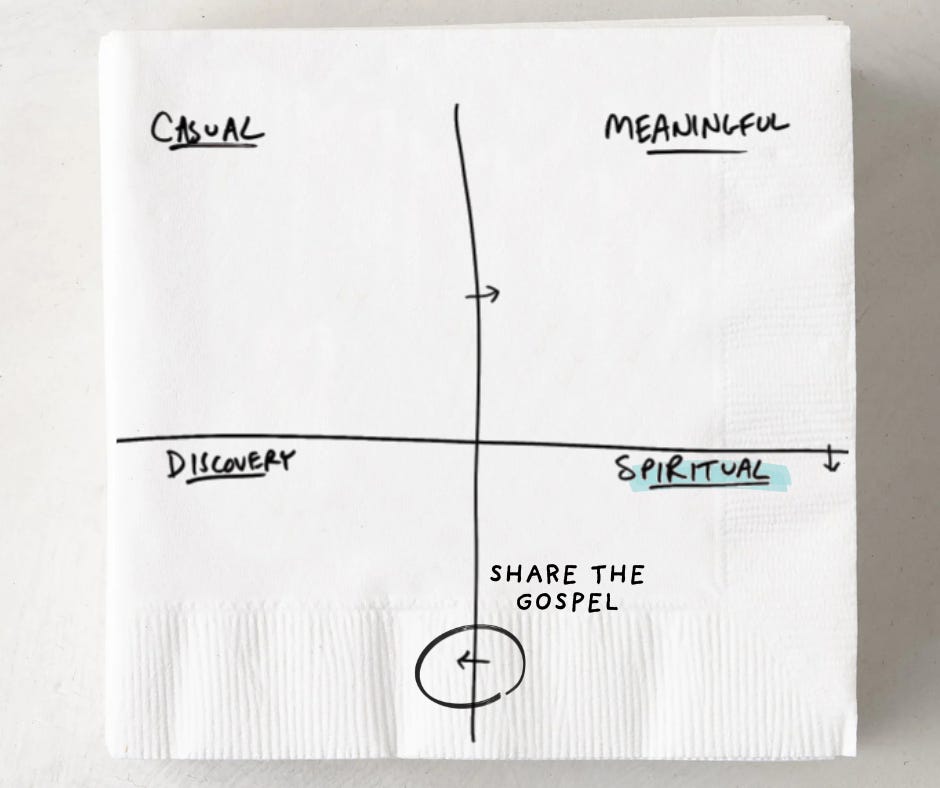
Do not grab it back.
They just heard your story. Now it’s time to share the gospel.
Keep it simple. Keep it clear.
Talk about sin. Talk about Jesus. Talk about the cross and resurrection. Talk about repentance and belief.
If you need a simple tool to guide the conversation, the 3 Circles Gospel Presentation walks through God’s design, brokenness, the gospel, and our response in a visual way anyone can learn.
Box 4 → Discovery
After you share the gospel, if they are not totally uninterested (this happens often), some people want to know more. Others are ready to follow.
Either way, you move to discovery.
Discovery requires an open Bible.
Not discovery posture. Not spiritual interest. An actual open Bible doing the work.
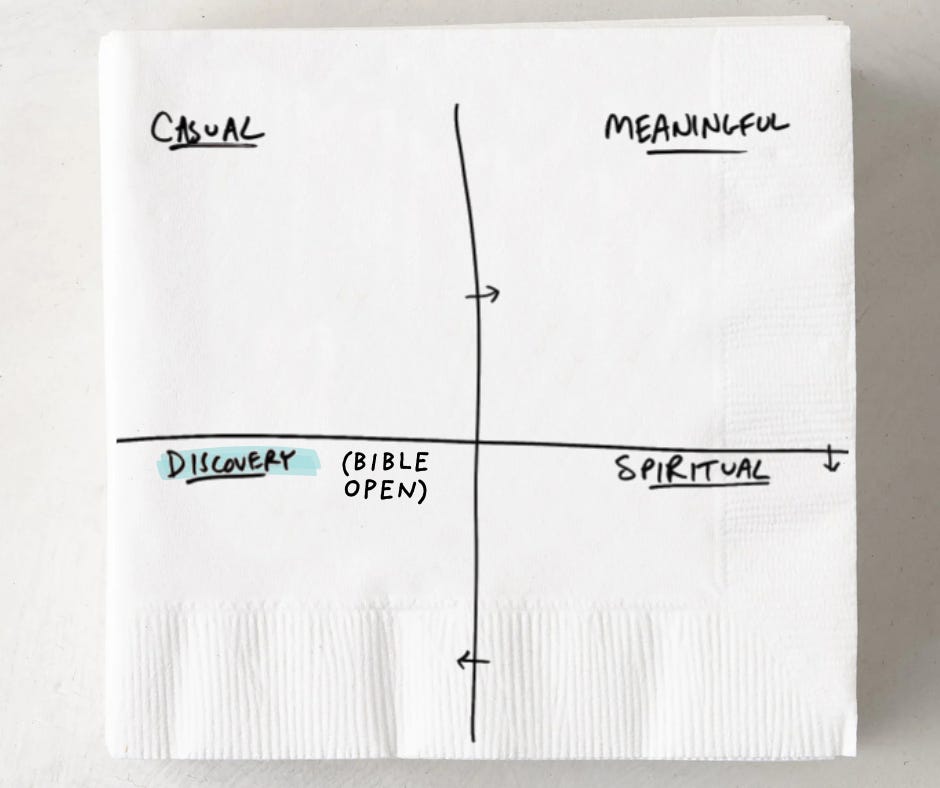
Open to Learning More
They have questions. They’re wrestling. They’re not closed, but they’re not ready to follow yet.
Open the Bible to a Story of Hope. Walk through the discovery questions together.
You’re facilitating, not teaching. Let the Word speak. Let them discover repentance and belief through Scripture, not through your answers.
Keep meeting. Keep the Bible open.
Why the arrows matter
Miss the arrow, you stay stuck.
You can live your whole life in meaningful conversations that never turn spiritual. You become everyone’s favorite therapist but nobody meets Jesus.
You can talk about Jesus all day and still never invite response. You become the religious guy who monologues but nobody’s life changes.
You can get to spiritual openness without ever sharing the gospel. People open up but never face the reality of sin and salvation.
Movement dies in the gaps.
The arrows carry people from where they are to where they need to go. Not in one giant leap. In small steps.
Each arrow is an invitation. Most people accept if you do it with kindness and respect.
But you have to use the arrow. It won’t happen by accident.
The fear
What if you do it wrong?
Sometimes you will. You’ll ask a question that lands flat. You’ll share your story and they’ll pivot. You’ll share the gospel and they’ll go red light.
Still better than intention that never gets past silence.
Skill comes from reps. Period.
Learn more about how it works here.
Identity call
You can become someone who helps conversations move.
Not by being intense. By being present, listening and sharing, and taking small risks.
That’s learnable. And ordinary people do it all the time.
Stop looking for talent. Start watching for faithfulness. That’s how leaders emerge. That’s how movements multiply.
Where to practice this
With a neighbor you’ve only done small talk with.
With your sphere of influence you already have.
With a barista you see weekly.
With one coworker you already trust.
With a family member who’s open but stuck.
Pick one. Use one arrow. That’s the whole plan.
Stop looking for better contexts. Start where you have access. Jesus did.
The assignment
Use one arrow this week.
Not the whole box. Just one move forward.
Pick a conversation that’s stuck in casual and ask a meaningful question or make a meaningful statement.
Or take a meaningful conversation and share how Jesus met you in something similar.
Or if you’re already talking about Jesus with someone, share the gospel. Read the traffic light. Respond accordingly.
One arrow.
And remember: the path to reaching multitudes runs through the doorstep. Your home, your table, your everyday rhythms: that’s where movements start.
Then tell me what happened.
Seriously. Comment or reply. I want to know.
Because when you use the arrows, stories happen. And stories are how this thing spreads.

Start here → https://obey.tools/
Join a 45 Min Skills Lab Zoom Call → https://covomultipliers.com/
Walk with others → https://forms.gle/YwqLhonNSipybAD8A
Great work. We need to acknowledge that real trust and relationships take time. We can be intentional and grow that trust, but it will take some time.
This is excellent. Too often we make evangelism an elevator pitch with one minute to recite the Romans Road. This is real and practical. Asking good questions is an art.