



There you are. Sitting in your car outside the dry cleaner at 7:48am, replaying a conversation from yesterday’s shift. A regular customer said something about his marriage falling apart. You said something vague and encouraging. He nodded and left. Door closed.
You knew there was more to say. You just didn’t know what.
So you moved on. You told yourself it wasn’t the right moment. You filed it under “complicated” and started the machines.
That’s not a character flaw. That’s a system problem. And it’s quietly killing your disciple-making.
The Question You Haven’t Asked
Most of us treat disciple-making like a design problem. We see a gap: the guy at the next workstation who never talks about anything real, the neighbor who shows up at the block party every year but you’ve never gotten past the weather. We start trying to build something to fill it. A reason to follow up. An approach that fits the relationship.
That seems responsible. It’s actually backwards.
The real question isn’t how do we build a pathway to make disciples? It’s is there already a pathway to discover?
That changes everything about how you show up.
If disciple-making is something you invent, then your experience is the raw material. You try things. You let what works shape what you do next.
But if it’s something you discover, if Jesus actually lived it out, if the early church actually modeled it, if it’s sitting right there in the text, then your experience isn’t the source. It’s the field where you apply what you already found.
Next Lab: “From Lost to Leader.” (Wednesday, May 20th at 3PM ET). Learn a simple path to help people move from far from God to growing disciple.
The Order of Operations
There’s a framework called the Wesleyan Quadrilateral. Don’t let the name scare you off.
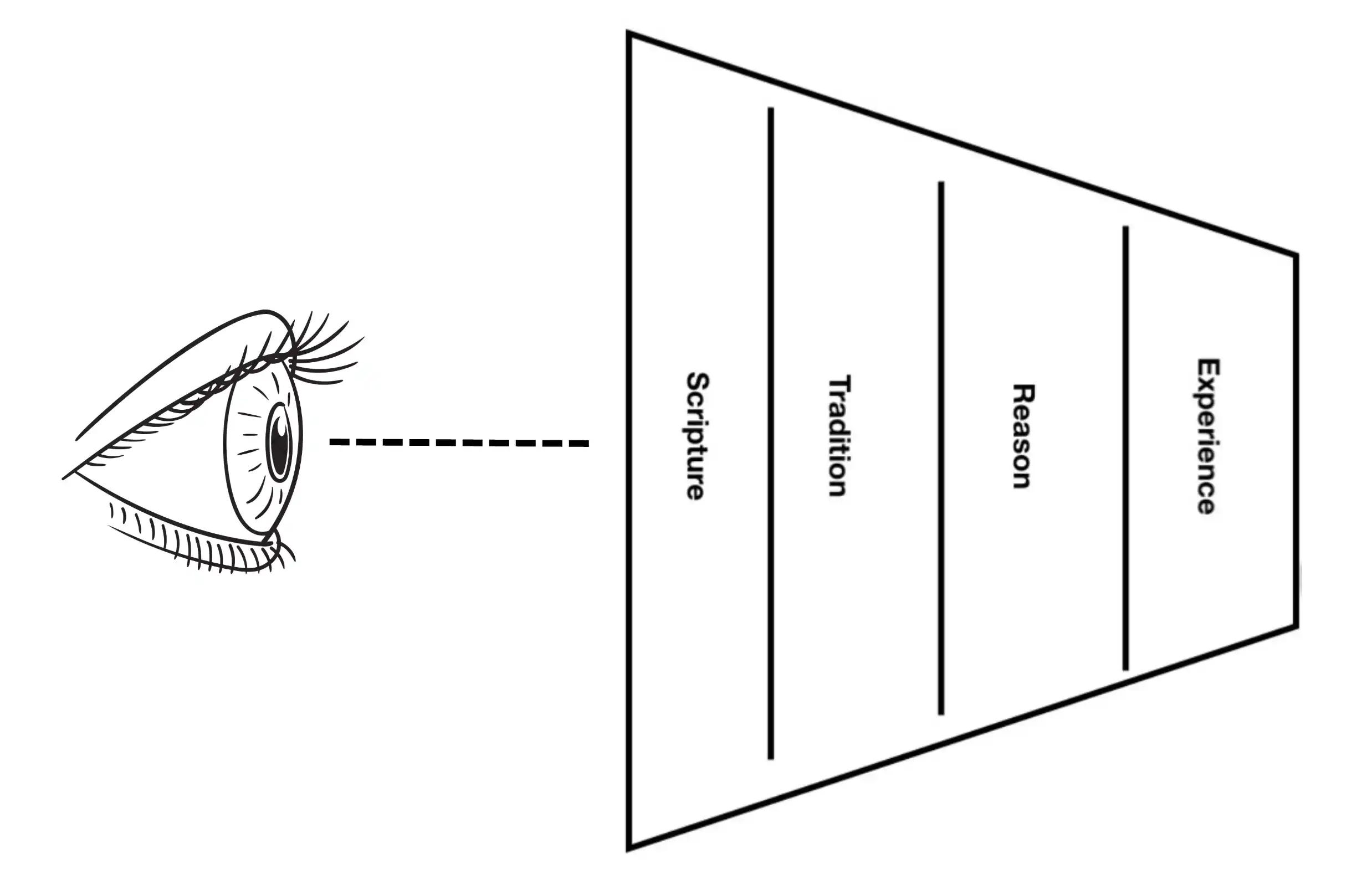
Scripture is the map. Tradition shows how the church has walked the road. Reason helps you think clearly. Experience is where your feet hit the pavement.
But most of us reverse the order.
The conversation with the customer hits you. It feels urgent and unresolved. So you reach back into whatever you remember from Sunday and try to find something that confirms the call you made, or didn’t make.
You think you’re being biblically grounded. You’re using the Bible to ratify whatever you walked in with.
Dave Miller, who plants churches while running a dry cleaning business, put it bluntly: most believers will say the Word of God is central to their life. But the vast majority of us are making our decisions in the experience category. We don’t have enough of the Word in our hearts that we’re actually letting it interpret our experience. We’re letting our experience interpret it.
That’s not cynicism. That’s just honest.
Why Experience Always Wins
Experience has an unfair advantage. The customer whose marriage is falling apart is real in a way that abstract theology rarely is. That 30-second window at the register, where you could have said something and didn’t, that’s real. You can replay it.
Theological debate doesn’t have that problem. You can argue the order of salvation on a Tuesday night and wake up Wednesday morning with zero practical consequences. The stakes feel invisible.
So we outsource our decision-making to whatever’s in front of us. The moment becomes the authority. Scripture gets consulted afterward, like a second opinion we’re not obligated to follow.
The result is a faith that bends to fit your week instead of a week that gets bent by your faith.
For a covocational leader trying to make disciples at a job, in a neighborhood, in the twenty minutes after hockey practice when everyone’s lingering by the cars, that’s a slow catastrophe. You’re not just trying to live differently. You’re trying to model something reproducible. If experience is driving, what people around you are watching is just someone trying their best. That’s not a movement. That’s a decent example at most.
Priscilla and Aquila Aren’t an Inspiration Story
They’re a case study.
Rome. Corinth. Ephesus. Back to Rome. Back to Ephesus. Across the snapshots we get of their lives, the same pattern keeps showing up: they’re working with their hands, and there’s a church meeting in their home. And they’re not just hosting. They’re leading citywide. In the mix with Paul, with Apollos, with the broader movement.
The work gave them access. The home gave people somewhere to land.
That’s Scripture doing what it’s supposed to do. Not giving you a feeling. Giving you a model.
So when the customer says his marriage is falling apart, you’re not scrambling for a religious line. You’re drawing on something you already studied. You’re asking what Scripture already taught you to do when peace opens a door.
Jesus Never Let the Pressure of the Moment Become the Authority
Crowds pressed him. Critics tested him. Gethsemane crushed him. But experience never told him who he was. The Father did. The Word did.
That’s the pattern we’re being formed into. Not a moral checklist you run before making a call. Christ formed in you, pushed outward through you into the ordinary Tuesday: the register conversation, the breakroom lunch, the parking lot after practice where everyone’s standing around and no one’s in a hurry yet.
Start With the Word
The next time someone opens a door, don’t start with your anxiety. Don’t start with what felt awkward last time. Don’t start with whether you think you’re ready.
Start with the Word.
Let Scripture tell you what kind of moment you’re standing in. Then obey.
The map exists. You just have to stop reading it backwards.

Start here → https://obey.tools/
Join a 45 Min Skills Lab Zoom Call → https://covomultipliers.com/
Walk with others → https://forms.gle/YwqLhonNSipybAD8A


